Order of Regular Adjectives
When you use more than one adjective to describe a noun, they must follow a certain order so
your sentence sounds natural.
The usual order is:
Opinion → Size → Age → Shape → Color → Origin → Material → Purpose → Noun
Example words in order:
Opinion: beautiful, delicious, comfortable
Size: big, small, tiny, huge
Age: old, young, ancient, new
Shape: round, square, oval
Color: red, blue, green, yellow
Origin: Filipino, American, Japanese
Material: wooden, plastic, cotton
Purpose: cooking, sleeping, reading
Sentence Example:
I saw a beautiful small old round blue Filipino wooden serving table.
My mother baked a delicious large freshly baked chocolate cake.
Degrees of Regular Adjectives
Adjectives can show different levels when describing something. There are three degrees:
Positive Degree – just describes the noun without comparing it.
The tall boy plays basketball.
Comparative Degree – compares two things; add -er to short adjectives or use more for
longer adjectives.
My house is bigger than yours.
This movie is more exciting than the last one.
Superlative Degree – compares three or more things; add -est to short adjectives or use
most for longer adjectives.
She is the fastest runner in the class.
This is the most beautiful dress in the store.
Examples Combining Order and Degrees
Positive:
Maria wore a lovely red silk dress to the party.
Comparative:
This cozy small cabin is warmer than the old one.
Superlative:
That is the most comfortable big brown leather sofa in the shop.
Are commas needed when ordering adjectives?
Yes — sometimes commas are needed when ordering adjectives, but not always.
Here’s the rule for Grade 6 level:
1. Use commas if the adjectives are “coordinate adjectives.”
These are adjectives from the same category (example: two opinions, or two sizes) and
equally describe the noun.
You can test this by:
Switching the order – if it still sounds natural, they are coordinate.
Adding “and” – if it makes sense, they are coordinate.
Example:
She wore a bright, colorful dress.
(Both “bright” and “colorful” describe the dress’s appearance, and you could say
“colorful, bright dress.”)
2. Do NOT use commas if the adjectives are “cumulative adjectives.”
These are adjectives that build on each other in a fixed order
(opinion → size → age → shape → color → origin → material → purpose → noun).
You cannot swap them without sounding awkward.
Example:
I bought a beautiful small wooden chair.
(You wouldn’t say “wooden small beautiful chair.” No comma needed.)
Quick Guide for Learners:
Same category → use comma.
Different category (following adjective order) → no comma.
Adjective Comma Test
Step 1 – Check if the adjectives are from the same category.
Examples of same category:
Two opinions: beautiful, colorful
Two sizes: big, wide
Two colors: red, blue
If YES, go to Step 2.
If NO, they are from different categories → No comma needed.
Step 2 – Try the “Switch Test.”
Swap the adjectives.
If it still sounds natural → Use a comma.
If it sounds strange → No comma.
Step 3 – Try the “And Test.”
Put “and” between the adjectives.
If it makes sense → Use a comma.
If it doesn’t make sense → No comma.
Examples:
With commas (same category / coordinate adjectives):
We saw a tall, strong athlete.
(Both are opinions about the athlete’s build; could be “strong, tall athlete.”)
She likes bright, cheerful colors.
(Both describe mood/appearance of colors.)
Without commas (different category / cumulative adjectives):
I have a beautiful small wooden chair.
(Opinion + size + material; fixed order, no comma.)
He drove a shiny red sports car.
(Opinion + color + purpose; no comma.)
Assessment 1
Part I – Order of Adjectives (5 points)
Arrange the adjectives in the correct order before the noun.
(blue, small, beautiful, Filipino, wooden) chair
→ _____________________________________________
(round, delicious, chocolate, large) cake
→ _____________________________________________
(American, interesting, old, long) story
→ _____________________________________________
(red, tiny, square) box
→ _____________________________________________
(comfortable, leather, big, black) sofa
→ _____________________________________________
Part II – Degrees of Adjectives (6 points)
Write the correct form of the adjective in parentheses.
- This exam is __________ than the last one. (easy)
- She is the __________ dancer in the group. (graceful)
- My dog is __________ than my neighbor’s dog. (friendly)
- That was the __________ day of my life. (happy)
- This puzzle is __________ to solve than the other one. (difficult)
- Our house is __________ and clean. (bright) – Positive degree
Part III – Comma Use in Adjectives (5 points)
Write the sentence correctly. Add commas where needed. If no comma is needed, write “Correct as is.”
- The hungry tired traveler sat by the fire.
- The little brown puppy followed me home.
- We stayed in a cold dark room.
- I saw a tall handsome actor at the event.
- She wore a sparkling blue gown.
Part IV – Application (4 points)
Write sentences using the given instructions.
- Write a sentence with three adjectives in the correct order before a noun.
- Write a sentence with a comparative degree adjective.
- Write a sentence with a superlative degree adjective.
- Write a sentence with two adjectives that need a comma.
Part V – Bonus Question (Optional – 5 points)
Explain the difference between coordinate adjectives and cumulative adjectives.
Order of Irregular Adjectives
Even when adjectives are irregular, we still follow the same order rule for multiple adjectives:
Opinion → Size → Age → Shape → Color → Origin → Material → Purpose → Noun
Example:
She has a lovely long ancient silver necklace.
(Opinion + length + age + color + noun)
Irregular adjectives still take their place in this order.
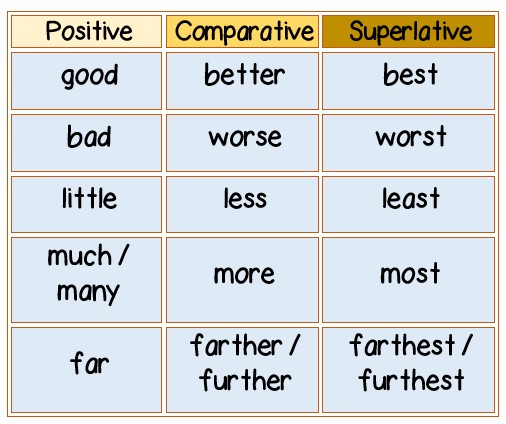
Example irregular adjectives: good, bad, far, little, much, many.
Degrees of Irregular Adjectives
Unlike regular adjectives, irregular adjectives do not follow the usual “add -er / -est” or “more / most” rule.
Instead, their forms completely change in comparative and superlative degrees.
Examples in Sentences (Positive Degree)
She is a good singer.
This is a bad idea.
We have many friends.
Examples in Sentences (Comparative Degree)
She sings better than her sister.
This plan is worse than the last one.
We have more books than before.
Examples in Sentences (Superlative Degree)
He is the best player in the team.
This is the worst storm we have experienced.
She read the most interesting story.
Combining Order and Degrees of Irregular Adjectives
Even with irregular adjectives, place them in the correct order with other adjectives.
Positive: (No comparison — just describes the noun in correct adjective order)
She wore a beautiful long good silk gown.
We visited a peaceful small old far mountain village.
He has a wonderful little much-loved wooden guitar.
We stayed in a pleasant large old white Italian villa.
Comparative: (Compares two nouns — irregular adjectives change form)
This is a better large wooden table than the one in the kitchen.
The worse short blue dress was taken off the display.
We traveled to a farther small mountain campsite than last summer.
She prepared a better delicious homemade pasta dish than yesterday.
Superlative: (Compares three or more nouns — irregular adjectives change form)
That is the best small red Italian restaurant in town.
He found the worst long dusty old road in the province.
This is the most beautiful large ancient stone castle in Europe.
She told the least exciting short boring story of the night.
Assessment 2
Part I – Identify the Degree (5 points)
Write whether the underlined adjective is Positive, Comparative, or Superlative.
- This is the best gift I have ever received.
- My handwriting is better now than last year.
- They have many friends in the neighborhood.
- Yesterday’s weather was worse than today’s.
- She told the least exciting story in class.
Part IV – Application (4 points)
Write your own sentences using irregular adjectives in the correct order.
- Sentence with a Positive degree irregular adjective:
→ ___________________________________________
- Sentence with a Comparative degree irregular adjective:
→ ___________________________________________
- Sentence with a Superlative degree irregular adjective:
→ ___________________________________________
- Sentence combining two or more adjectives (at least one irregular) in correct order:
→ ___________________________________________
Part V – Bonus (Optional – 5 points)
Explain in your own words why “good, better, best” are considered irregular adjectives.
Part II – Correct Form of the Adjective (6 points)
Write the correct irregular adjective form in each blank.
- Our old car is __________ than this new one. (bad)
- This is the __________ day in my life. (good)
- He has the __________ energy in the group. (little)
- We need __________ chairs for the meeting. (many)
- This road is __________ from the school than the other one. (far)
- My cooking is __________ this year than last year. (good)
Part III – Arrange in Correct Order (5 points)
Arrange the adjectives in correct order before the noun.
- (Filipino, best, small, wooden) restaurant
→ ___________________________________________
- (old, bad, large, blue) sofa
→ ___________________________________________
- (many, beautiful, ancient, stone) temples
→ ___________________________________________
- (worst, little, plastic, green) container
→ ___________________________________________
- (farther, dusty, long, rough) road
→ ___________________________________________